Advance Care Centre For Piles
What is Piles?
Swollen and inflamed veins in the rectum and anus that cause bleeding and discomfort are called Piles or Haemorrhoids. It is a common disorder affecting men or women of any age group caused by the constant pressure on blood vessels present in the anal area. Because of this constant pressure, the capillaries become weak and gives irritable feeling while passing the bowel.
Piles are also known as Bavasir in Hindi or Mulvyadh in Marathi.
Treating Piles
There are two ways of treating piles: Operative and Non-operative. Usually, people attempt to treat the piles through the non-operative method. This includes:
- Gradually increasing the fibre content in the diet,
- Increasing the water intake,
- Immediately emptying bowel as per the body signal
- Maintaining appropriate body weight
- Regularly exercising to regulate circulation
However, sometimes the matter cannot be solved even after bringing about a major change in the lifestyle. At such a point, the doctors recommend undergoing a surgery for the same.
At Eravio, we understand that the thought of a surgery may seem intimidating. However, we employ the minimally to non-invasive techniques to treat piles. The most common treatments are laser treatment and stapler treatment.
Laser Haemorrhoidoplasty for Treating Piles
At Eravio Hospital, we have the best doctors for proctology who are adept at using the latest technology with expertise.
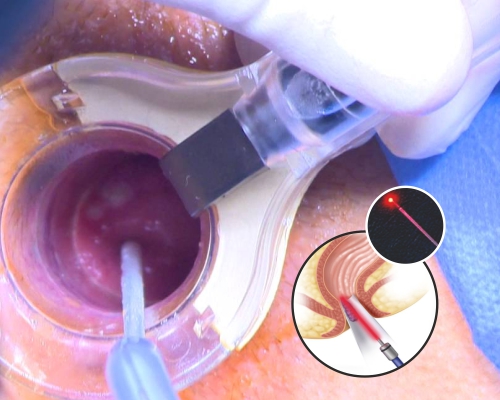
Under Local Anaesthesia (LA)/General Anaesthesia (GA), the laser device delivers laser energy in a radial manner directly to the haemorrhoidal nodes. This results in obliteration of the nodes while preserving the mucosa and sphincter structure to an extremely high precision.
The laser energy seals off the blood vessels which nourish abnormal growth. It induces destruction of the venous epithelium and simultaneous obliteration of the haemorrhoidal pile by a shrinkage effect.
When compared to the conventional surgery, the laser energy encourages fibrotic reconstruction to generate new connective tissue. This ensures that mucosa adheres to the underlying tissue and prevents any relapse. This procedure takes only a few minutes.
Laser Treatment vs Surgery
Main Feature
- Patient Hospital Stay
- Post-Operative Pain
- Recovery Time
- Recurrence
- Complications
Laser
- 24 Hours
- Low
- 3 days
- Low
- Low
Surgical Procedure
- 3 to 7 days
- High
- 7-15 days
- High
- High
Types of Piles
There are two types of Piles:
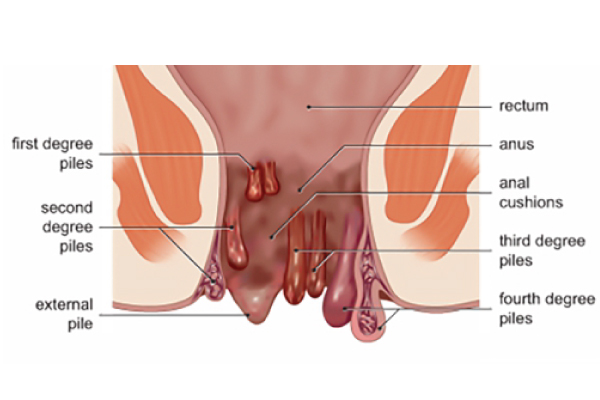
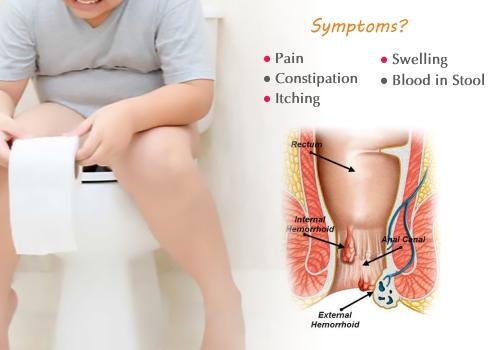
- Internal Haemorrhoids: Develop near anal area and identified by bleeding. They are painless and one cannot feel its presence as they are present inside the anus.
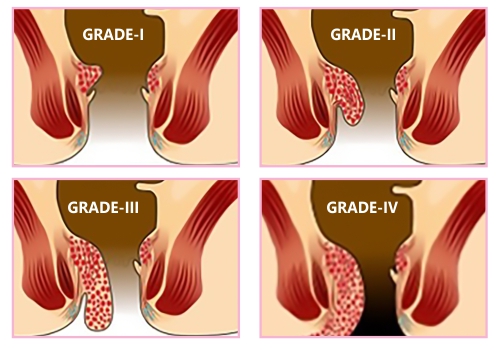
- The internal haemorrhoids are classified under four classes as follows:
- Grade I: No protrusion from the anus.
- Grade II: Minor bulging via anus during straining and bowel movement but spontaneously acquire original position
- Grade III: Comes out of the anus with the bowel, but inserted back using a finger.
- Grade IV: Project from the anus and cannot revert to its original place.
- External Haemorrhoids: Develop outside the anus and are the most troublesome. They cause pain, severe itching and difficulty in sitting.
Symptoms of Piles
- Difficulty in passing stool
- Bleeding during bowel movement
- Itchiness around the anus
- Swelling around the anus and discomfort
- Presence of tissue mass or lump in anorectal area
- Tissue with piercing pain
- Leakage of faeces or slime from anorectal area
- Incomplete bowel discharge even after having bowel movement
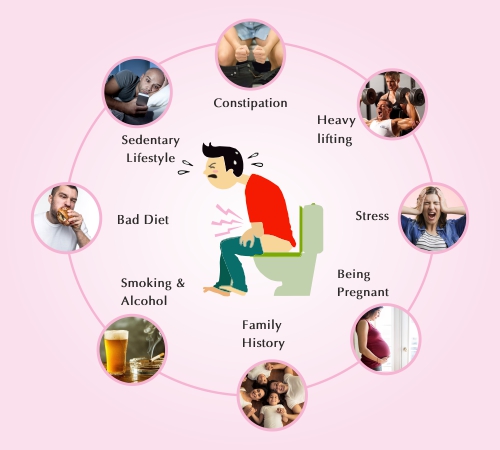
What Causes Piles?
- Constipation
- Extreme strain during bowel discharge
- Prolonged diarrhoea
- Genetics
- Pregnancy
- Massive weightlifting
- Severe cold and cough
- Consumption of poor or low fibre diet
- Extreme stress
- Injuries caused by previous rectal surgeries and damaged spinal cord
- Prolonged sitting in one place
What are the precautions I should take before and after the procedure?
Dr. Kalyan Kar
MS, FRCS(EDIN) GENERAL & LAPAROSCOPIC SURGEON
Application of DIODE LASER in the treatment of haemorrhoids, fistula and fissure has developed in last 10 years. Learn the Proper and Safe Usage of Laser, Basic and Advanced Techniques of Laser Surgery from the best mentor Dr Kalyan Kar.
Things you should know about Piles
The following are the causes of piles:
- Constipation
- Extreme strain during bowel discharge
- Prolonged diarrhoea
- Genetics
- Pregnancy
- Massive weightlifting
- Severe cold and cough
- Consumption of poor or low fibre diet
- Extreme stress
- Injuries caused by previous rectal surgeries and damaged spinal cord
- Prolonged sitting in one plac
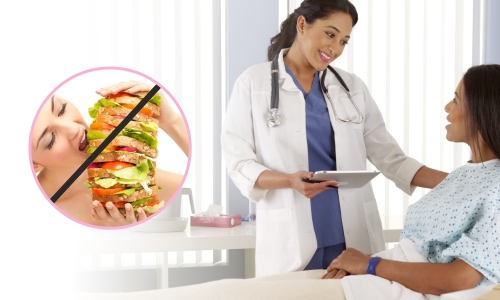
Before the surgery, perform the following actions:
- Follow a strict routine for bowel movements
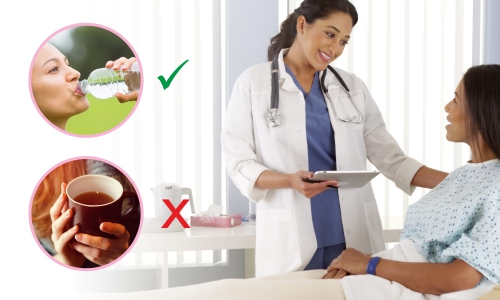
- Avoid a heavy meal on the night before the procedure (you can drink water till up to 4 hours before the procedure)
After the surgery, perform the following actions:
- Seek help from family or caregivers
- Take a shower to ensure cleanliness
- Take prescribed medication as directed
- Drink adequate amount of fluids
- Do not remove the dressing from the operative wounds
- Do not consume drinks like coffee or tea

No. Piles is not restricted to merely old people. Anyone can suffer from piles. This is a myth.
- Only sick and old people develop haemorrhoids
- It is not possible to completely cure haemorrhoids
- Hot and exotic foods cause piles
- Haemorrhoids can cause carcinoma
- You should not exercise if you are suffering from piles
It is important to educate yourself about Piles. Eravio Hospital has some of the best doctors in the nation who not only treat conditions such as piles but also provide the right counselling for the same.